A bespoke suit usually needs two to three fittings after your first consultation: a baste fitting, a forward fitting and a final fitting. In Dubai, the whole process from consultation to collection typically takes six to eight weeks. Some suits need a fourth fitting, for example on a first commission for a less standard build or when your weight changes during the process. A made-to-measure suit, by contrast, usually needs one. This guide explains how many fittings a bespoke suit needs, what happens at each one and how to get the most from them.
The fittings at a glance
| Stage | Approximate timing | What it is for |
|---|---|---|
| Consultation and measurements | Week 0 | Cloth, style, measurements and posture notes; your pattern is drafted |
| Fitting 1: baste | Around weeks 2 to 3 | Balance, shoulders, chest and overall proportion |
| Fitting 2: forward | Around weeks 4 to 5 | Collar, sleeves, waist and trouser line, refined |
| Fitting 3: final | Around weeks 6 to 8 | Final lengths and finishing, then collection |
Timings are a guide. Cloth availability, the season and your own diary all affect the schedule, and your tailor will confirm dates as you go.
Before any fitting: the consultation and measurements
The first appointment is not a fitting, but everything depends on it. You talk through what the suit is for, how often you will wear it and where: a business rotation in DIFC needs something different from a wedding suit or a dinner jacket. You choose the cloth, then the details, such as the lapel, the number of buttons, the pockets, the vents and the lining.
Then come the measurements. A bespoke tailor takes far more than the chest, waist and inside leg. They also note how you stand: whether one shoulder sits lower than the other, whether you stand slightly forward or upright, and how your arms hang. From these, your personal paper pattern is drafted. It is this pattern, drawn for you from scratch, that separates bespoke from made-to-measure.
Fitting 1: the baste fitting
At the baste fitting, the jacket is held together with loose, contrasting tacking stitches, and the canvas is in place but not yet fixed. It can look unfinished, often with one sleeve missing and no buttonholes. That is deliberate: the tailor wants a garment that can be taken apart and recut easily.
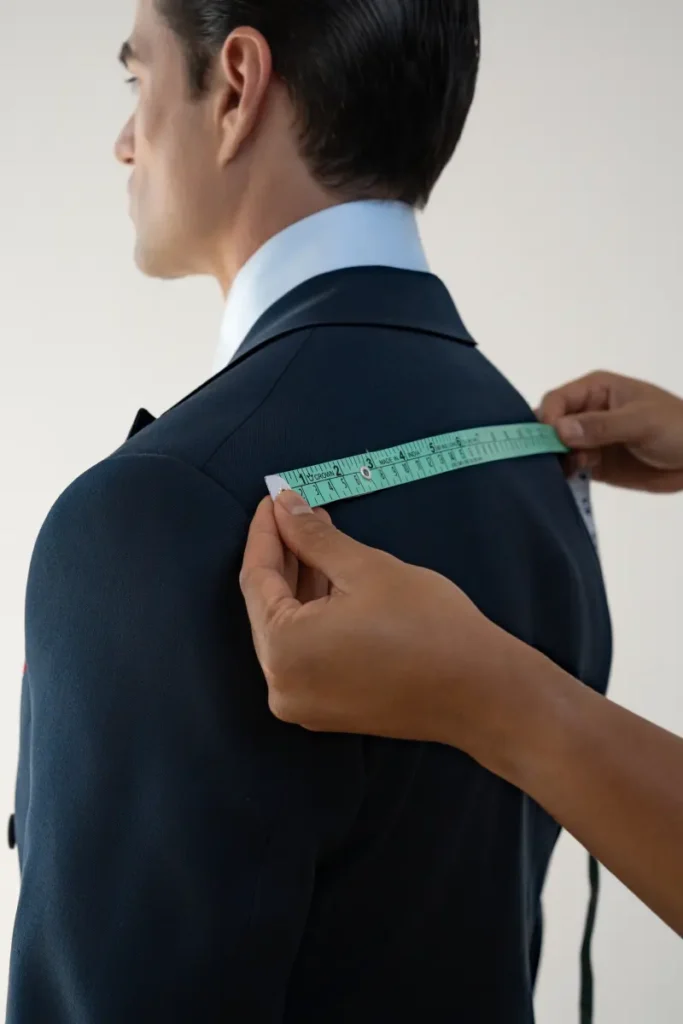
This fitting is about the fundamentals. The tailor checks the balance of the jacket, meaning whether the front and back hang evenly, then the shoulder line, how the chest sits and the overall length. Expect chalk marks, pins and sometimes a seam opened up there and then. The trousers are checked for rise, seat and waist.
What to do: stand as you normally stand, not as straight as you can. Wear the kind of shirt and shoes you plan to wear with the suit, and keep your phone and wallet where you usually keep them. If anything feels tight or restrictive, say so now, because this is the easiest stage to change it.
Fitting 2: the forward fitting
After the baste fitting, the suit is recut and taken further forward. The collar is attached, both sleeves are set and the garment looks much more like a suit.
The forward fitting refines the details. The tailor looks at how the collar sits against your neck, the pitch of the sleeves (the angle at which they hang from the shoulder), the shape through the waist and the line of the trousers down to the break over your shoe.
What to do: move. Sit down, reach forward, raise your arms as if hailing a taxi, and turn as you would to get out of a car. A good bespoke suit should look sharp when you are still and stay comfortable when you are not.
Fitting 3: the final fitting
At the final fitting, the suit is essentially finished: buttonholes worked, linings in and the garment pressed. The tailor checks the finishing details, such as sleeve length relative to your shirt cuff and the final trouser length, and makes any last small adjustments. If everything is right, you take the suit home, or it is delivered to you.
Why does bespoke need more fittings than made-to-measure?
Made-to-measure starts with a proven block pattern that is adjusted to your measurements, so one fitting is usually enough to check it. Bespoke starts with a blank sheet. Your pattern has never been made before, and the jacket is built around a canvas that is shaped by hand through the chest and lapel. Each fitting lets the tailor see that pattern on your body, correct it and refine it before the next stage. That is how a bespoke jacket ends up following your posture rather than sitting on top of it.
If you are still deciding which route suits you, our guide to bespoke vs made-to-measure vs semi-bespoke compares fittings, lead times and price bands side by side.
When might you need an extra fitting?
Most clients need two to three fittings. A fourth may be worthwhile when:
- It is your first bespoke commission and your build sits well outside standard sizing.
- Your weight changes between fittings, which is common for grooms training before a wedding.
- There is a long gap between fittings, for example over the summer, when many Dubai residents travel.
- The garment is more complex, such as a double-breasted jacket or a three-piece suit with a waistcoat.
The good news is that your pattern is kept on file. Later commissions start from a pattern already refined on your body, so they can often need fewer fittings than the first.
How to get the most from your fittings
- Bring the shoes you will wear with the suit. They decide where the trousers break.
- Wear a well-fitting shirt with a collar and cuffs like the ones you will wear.
- Carry what you normally carry. Pockets change how a jacket hangs.
- Be candid. Your tailor would rather hear “the armhole feels high” at the baste fitting than notice you avoiding the suit later.
- Keep the gaps sensible. Fittings two to three weeks apart keep the commission moving without rushing the work.
Can fittings take place at home or in the office?
Yes. Through The Moving Tailor, consultations, measurements and every fitting can take place at your home, office or hotel anywhere in Dubai, or at our atelier in Oud Metha if you prefer. For time-poor clients, this is often what makes three fittings practical. Our guide to how a home tailor visit works in Dubai explains what to expect.
How long does it all take?
Allow six to eight weeks for a bespoke suit and four to six weeks for bespoke trousers on their own. For a wedding, start eight to twelve weeks before the date so there is time for every fitting without pressure. Our bespoke suits in Dubai page explains the construction, cloths and process in more detail.
To begin, book an appointment or message us on WhatsApp at +971 56 506 6543. Tell us when you need the suit, and we will plan your fittings around it.
Frequently asked questions
How many fittings does a bespoke suit need?
Usually two to three after the initial consultation and measurements: a baste fitting, a forward fitting and a final fitting. A fourth is occasionally needed for a first commission, a change in weight or a more complex garment.
How long does a bespoke suit take in Dubai?
Typically six to eight weeks from consultation to collection, including all fittings. Start eight to twelve weeks ahead for a wedding or an important event.
What should I wear to a suit fitting?
Wear the shoes and a shirt like the ones you plan to wear with the suit, and carry your phone and wallet as usual. All three affect how the suit hangs.
Will my second bespoke suit need as many fittings?
Often fewer. Your pattern is kept on file and has already been refined on your body, so later suits start from a proven pattern rather than from scratch.
Can I have my bespoke suit fittings at home in Dubai?
Yes. The Moving Tailor visits homes, offices and hotels across Dubai for consultations, measurements and fittings, so you never need to visit the atelier unless you want to.